
What is a Grolar Bear?
Written by: Joel Weatherly, Wildlife Photographer & Naturalist
Polar Bear Meets Grizzly
Grizzly Bears and Polar Bears are two of Canada’s most iconic mammals, but what happens when they meet and mix?
Grizzly Bears (Ursus arctos horribilis) and Polar Bears (Ursus maritimus) are closely related members of the bear genus Ursus, with the Polar Bear thought to have diverged from the brown bears as recently as 150,000 years ago. Grizzly Bears generally live a terrestrial lifestyle in western Canada, while Polar Bears are both terrestrial and pagophilic (ice-loving), spending much of the year venturing across sea ice in arctic Canada.
While seemingly distant, the ranges of these two bears overlap in Nunavut and northern Manitoba, close to where we view Polar Bears in the Churchill Wildlife Management Area on our One-Day Polar Bear Safaris. Climate change is altering the ranges of both bear species, forcing Polar Bears to spend more time on land and allowing grizzlies to move farther north and east. Where these two bears meet, they occasionally mate, producing a hybrid bear sometimes known as the Grolar Bear or Pizzly Bear and scientifically known as Ursus maritimus x U. arctos.
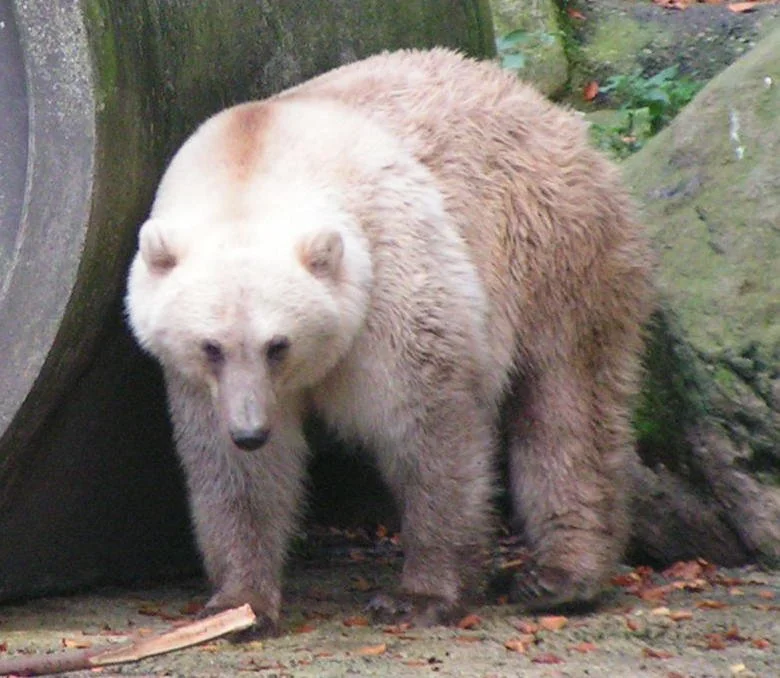
Photo of a Grolar bear via Wikimedia Commons.
Are Hybrids Common?
While it is thought that Grizzly Bears and Polar Bears have hybridised for thousands of years, sightings of Grizzly-Polar Bear hybrids are a relatively recent phenomenon. Hybrids have been produced in zoos for several decades, and the first wild hybrid was found on sea ice in the eastern Beaufort Sea in 2006. Four years later, another wild bear was found on Victoria Island. Genetic analysis of the first wild hybrid showed that it had a Polar Bear mother and a Grizzly Bear father. Analysis of the second bear yielded an unexpected result: it was found to have a Grizzly-Polar bear hybrid mother and a Grizzly Bear father. This revealed not only that more hybrids were likely roaming Canada’s North, but also that they were fertile and capable of interbreeding, creating second-generation hybridised bears.
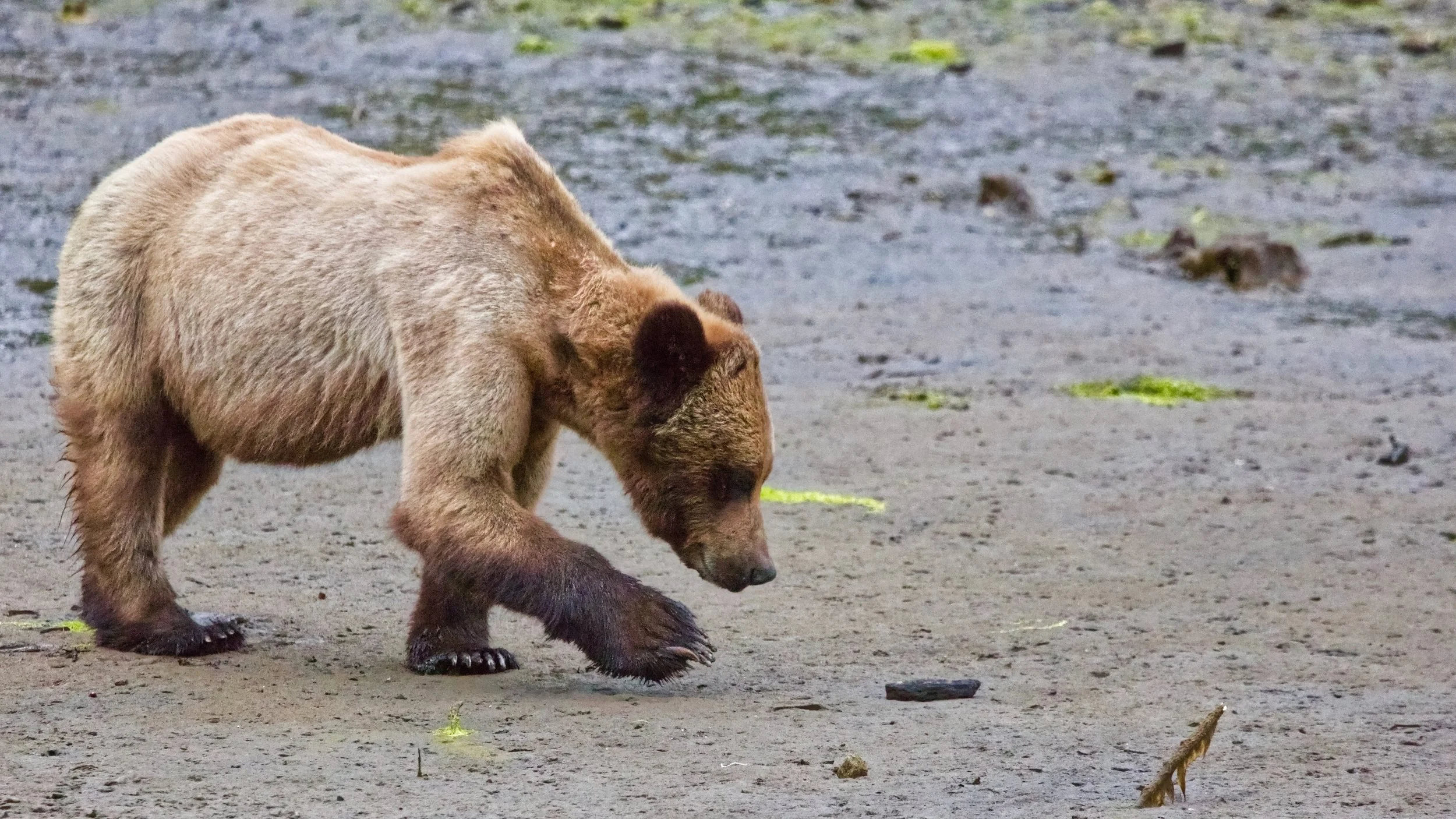
A Grizzly Bear in the Khutzeymateen Valley. This bear is demonstrating adaptations, like a muscular humped back and long curved claws that allow it to live a terrestrial lifestyle. (Joel Weatherly Photography)
Are Hybrids More Grizzly or Polar Bear?
These hybrid bears possess a mix of features from both parents, including light brown fur with both hollow and solid hairs, claws that are longer than a polar bear’s and shorter than a grizzly's, and an intermediate neck length. The behaviour of hybrid bears bred at the Osnabrück Zoo in Germany was more similar to that of Polar Bears, including stomping on toys and lying down on their bellies with legs splayed. While both Polar Bears and Grizzly Bears are highly adapted to their natural habitats, their hybrids are not as well-adapted, lacking the highly specialised adaptations of their parent bears.
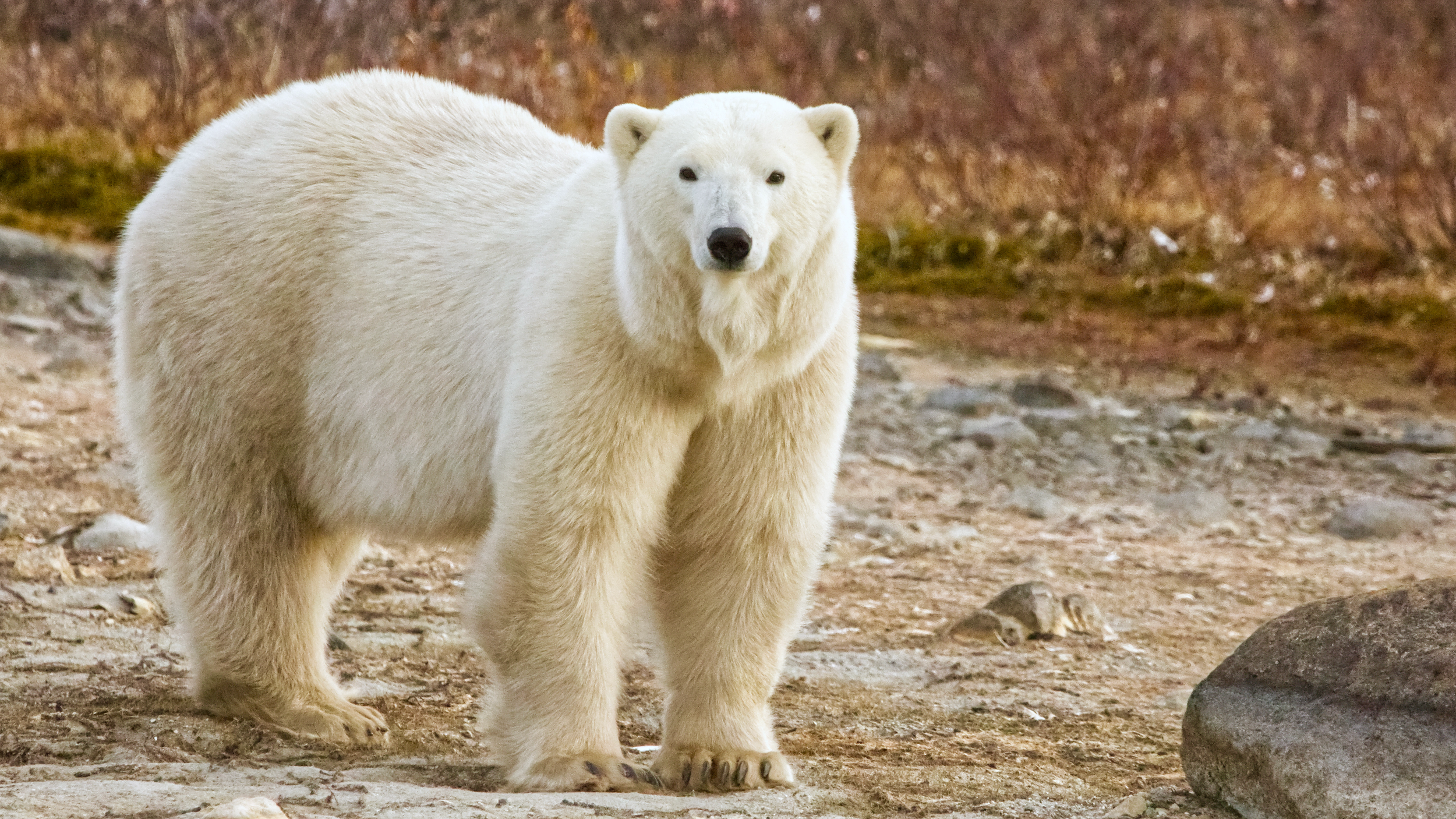
A Polar Bear in the Churchill Wildlife Management Area. Polar Bears have many adaptations, including a long neck and thick fur with hollow hairs that appear white. (Joel Weatherly Photography)
While hybridisation presents a fascinating natural curiosity, it also highlights how significantly our rapidly changing climate impacts the ranges and behaviours of these vulnerable bears.
Sources
Lindqvist, C., Schuster, S. C., Sun, Y., Talbot, S. L., Qi, J., Ratan, A., Tomsho, L. P., Kasson, L., Zeyl, E., Aars, J., Miller, W., Ingólfsson, Ó., Bachmann, L., & Wiig, Ø. (2010). Complete mitochondrial genome of a Pleistocene jawbone unveils the origin of polar bear. Proceedings of the National Academy of Sciences, 107(11), 5053–5057. https://doi.org/10.1073/pnas.0914266107
William L. Gannon, Derocher, A. E., and W. Lynch. 2012. POLAR BEARS: A COMPLETE GUIDE TO THEIR BIOLOGY AND BEHAVIOR. Johns Hopkins University Press, Baltimore, Maryland, 264 pp. ISBN 978-1-4214-0305-2, Pages 40-41, https://doi.org/10.1644/12-MAMM-R-159
BBC - Earth News - Polar bear plus grizzly equals? (n.d.). BBC. http://news.bbc.co.uk/earth/hi/earth_news/newsid_8321000/8321102.stm

