
Aurora 101: Seeing the Northern Lights
Written by: Joel Weatherly, Wildlife Photographer & Naturalist
The Aurora Borealis, also known as the Northern Lights, are certainly a pretty sight, but what’s actually going on? Let’s dive into the science behind the lights.
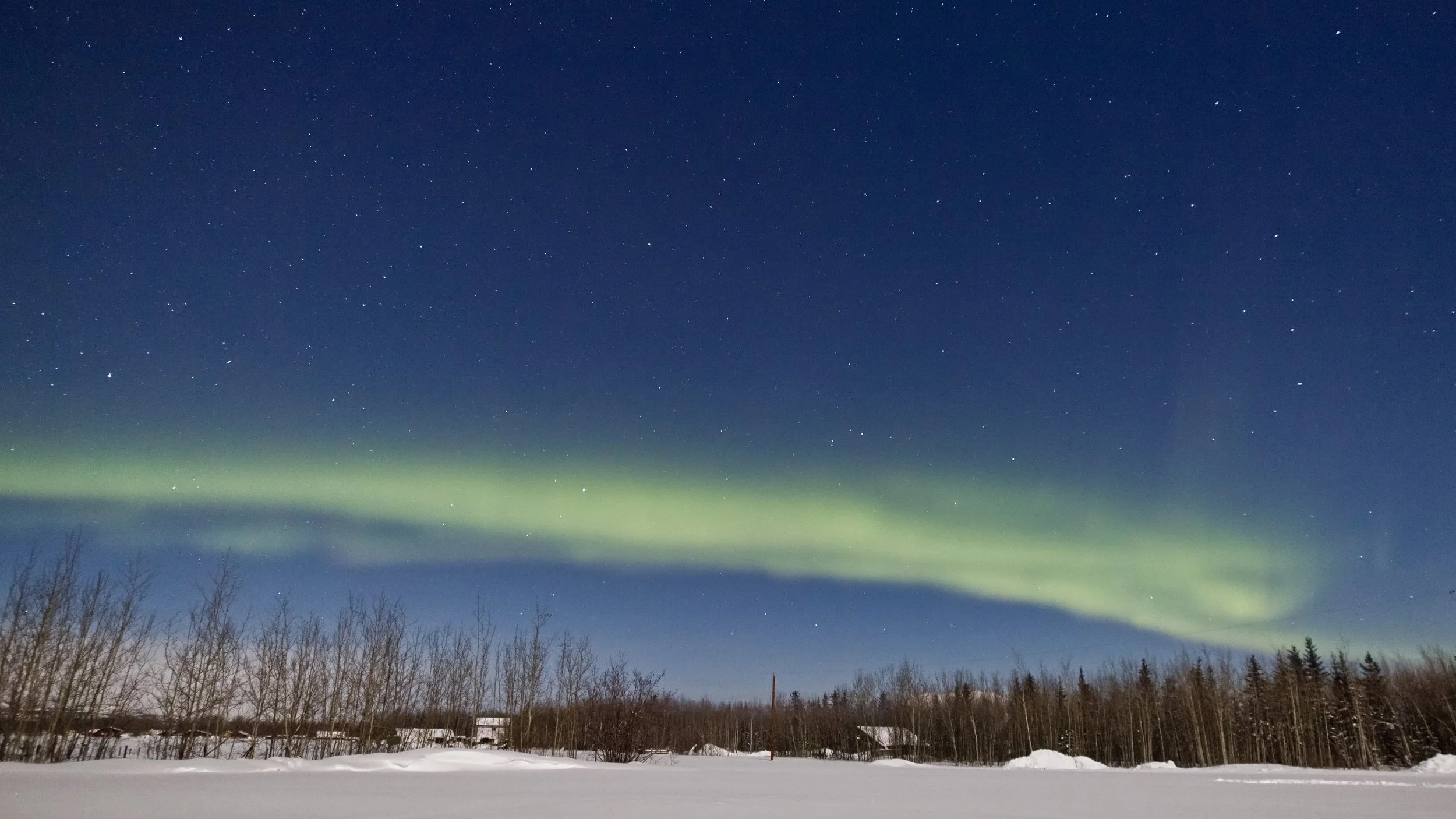
Photo the Aurora Borealis during our February 2026 Whitehorse Northern Lights Tour. (Credit: Joel Weatherly)
What Causes an Aurora?
Auroras are driven by solar activity. The Sun is an active and dynamic star with looping magnetic fields, a nuclear fusion-fueled core, ever-changing active regions, and a mysterious outer atmosphere. All this activity generates a stream of particles from the Sun called the solar wind. The particles emanating from the Sun have immense energy and magnetism. When “gusts” of solar wind particles arrive at Earth, they interact with Earth’s protective magnetic field, which shields us from most of their impacts. Some energetic particles do get entrained within Earth’s magnetic field and funneled down toward our magnetic poles. As they approach the planet, the particles collide with our atmosphere and excite the atmospheric gases making them give off light, producing the auroras.
A Colourful Sight
Depending on the gases getting excited and the amount of energy involved, auroras can come in many different colours. The most frequently observed colour is green, produced by oxygen at altitudes of roughly 100-300 km. To the human eye, this light often appears greyish or even white, with the green displaying most clearly during heightened periods of activity. At times, oxygen can produce red light. This haunting red hue is most often seen during intense geomagnetic storms, when higher-altitude oxygen is excited and has more time to release its energy. Other gases, such as nitrogen, hydrogen, and helium, can produce blues and purples, but these colours are rarely observed with the naked eye, as we are poorly adapted to seeing them at night. Closer to the ground, nitrogen can add a pink fringe to the bottom of an aurora, often a stunning and eye-catching addition to an already exciting sight.
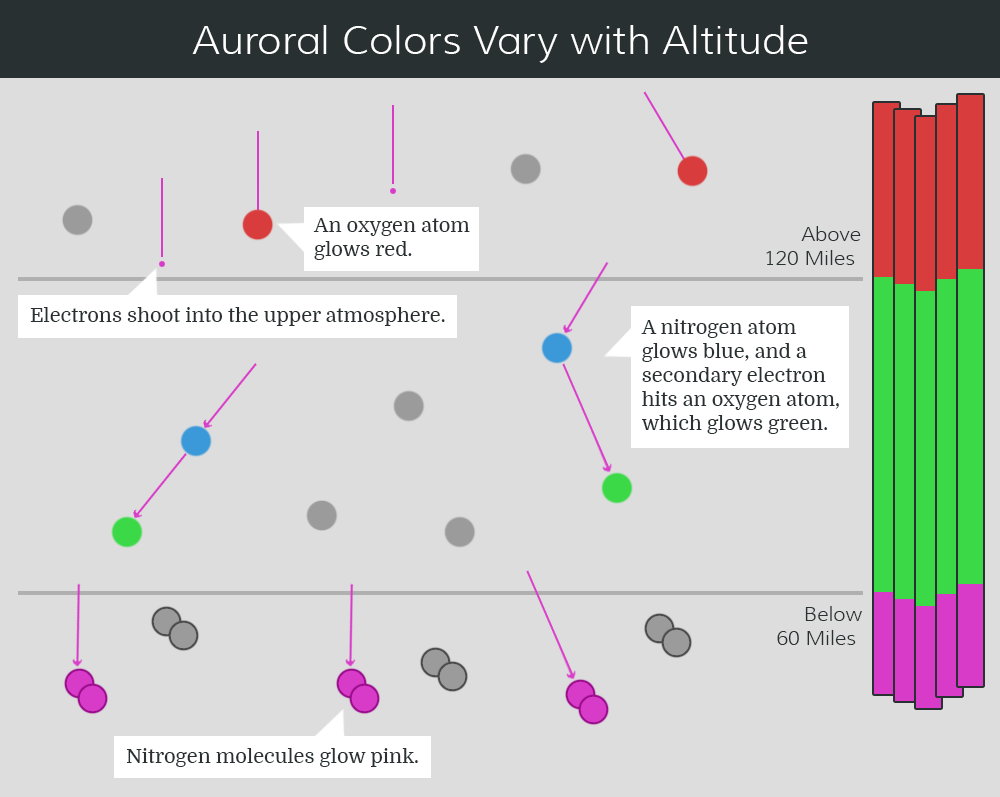
The colours of the aurora depend on the altitude above Earth and the gases which get excited by the solar wind. (Credit: NASA/Aurorasaurus)
When is the best time to see auroras?
Auroras can happen at any time. They are seen from somewhere on Earth at virtually any time of year and at any time of the night. Statistically, auroras are most frequently seen around the equinoxes in March and September, due to Earth’s magnetic field being well aligned with the Sun’s. To make equinoxes even more appealing, around that time, we also get a reasonable amount of nighttime to spend aurora chasing, and the weather is often milder than the favourably dark, but unfavourably cold winter. The best time to view active auroras is typically 10:00 pm to 2:00 am local time, though it can vary depending on geomagnetic activity. During particularly intense storms, auroras can be seen from sunset until sunrise.
Solar activity varies across a roughly 11-year solar cycle. During solar maximum, the Sun is most active, and auroras are observed frequently with great intensity. At solar minimum, the Sun becomes quiet and auroral displays are less frequent. At this time (2026), we are in the midst of solar cycle 25, which peaked around 2024 and remains active.
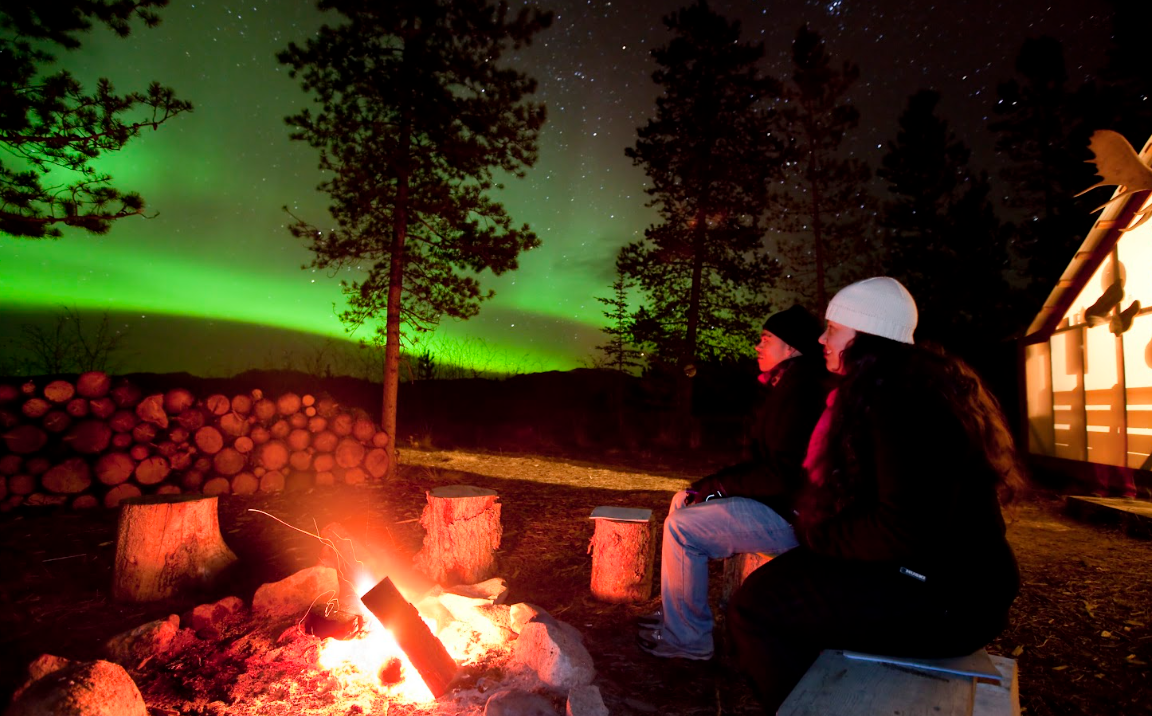
Seeing the aurora at the Northern Lights Viewing Site near Whitehorse, Yukon.
Aurora Viewing Locations
Auroras are most frequently observed within the auroral zones that encircle Earth’s north and south magnetic poles. The magnetic poles and geographic poles are slightly offset, with the northern magnetic pole presently tilted towards Canada, but it is moving towards Russia at about 55-60 km per year. Places in Canada within the auroral zone include the Territories and the northern portions of some provinces. As auroras can be faint and diffuse, choosing a location with minimal light pollution is best. For these reasons, we visit the Yukon for our four-day, three-night Whitehorse Northern Lights Tours. Near Whitehorse, we are well placed in the auroral zone, have access to dark skies, and have the potential for clear skies and good weather.
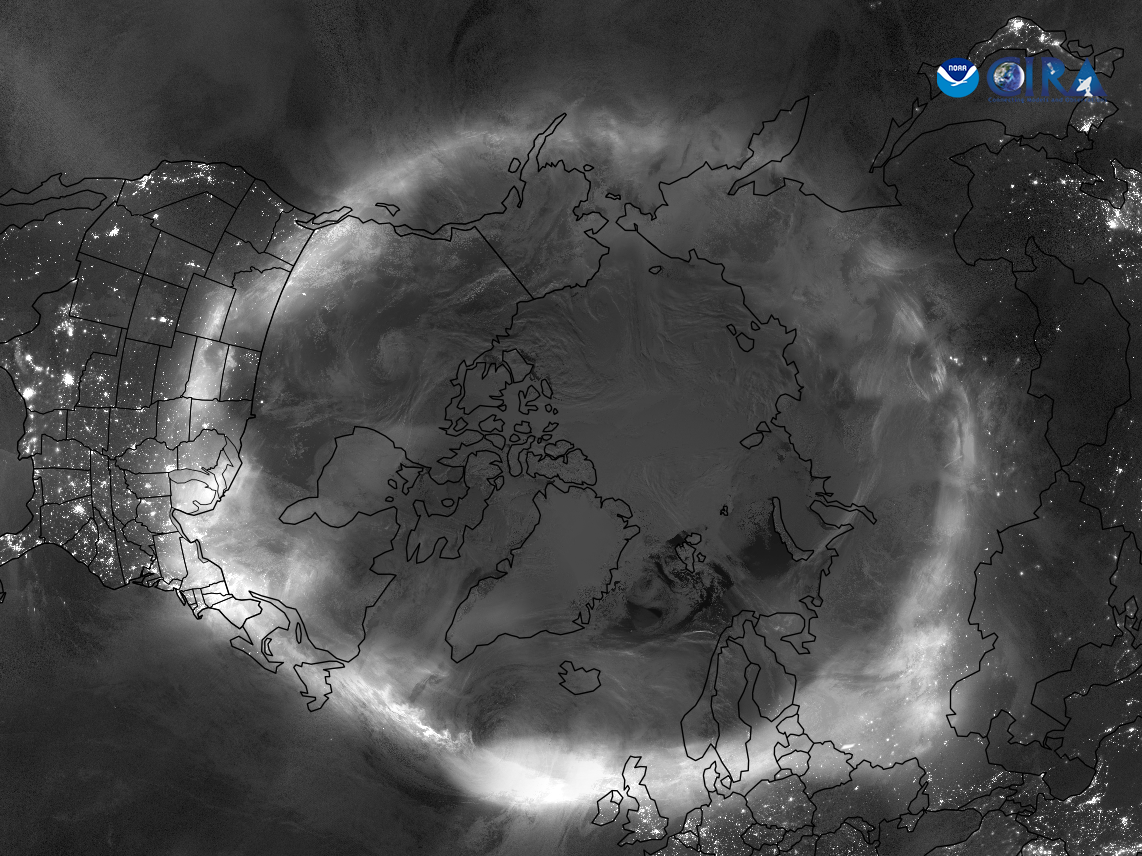
This image, taken from a satellite, shows the Northern Lights during a strong space weather event, highlighting where auroras were visible around Earth’s polar regions. (Credit: Cooperative Institute for Research in the Atmosphere)
Forecasting an Aurora
Similar to forecasting our familiar terrestrial weather, forecasting space weather is a bit of a challenge. To monitor solar activity, several Earth and space-based observatories keep a close eye on the Sun, watching for sunspots, solar flares, and coronal mass ejections, which are all factors in sending streams of solar material towards Earth. On Earth, magnetometers monitor the planet’s magnetic field for disturbances due to solar activity. Between Earth and the Sun, several spacecraft are equipped with sensors to measure the speed and density of the solar wind, as well as the energy of the particles within it.
Combining all this data allows space weather forecasters to predict when auroras might appear. While space weather forecast accuracy has improved dramatically in recent years, there is always a bit of uncertainty, so it’s always worth watching for an unexpectedly exciting show.
Some great resources for aurora forecasts include:
SpaceWeatherLive.com
This website and app collect space weather data from many sources. They provide aurora alerts and forecasts so you can track when northern lights activity is increasing.
Link: Spaceweatherlive.com
Space Weather Canada
A helpful Canadian resource that shows space weather conditions by region. It’s a quick way to see whether aurora activity is likely in your area.
Link: Space Weather Canada
Space Weather Prediction Centre
A leading U.S. source for space weather forecasting. Their Aurora Dashboard shows where auroras may be visible and how strong activity is expected to be. The Kp index is a simple scale (0–9) that indicates how active the geomagnetic conditions are — the higher the number, the better the chance of seeing auroras.
Link: Aurora Dashboard
Join us on an upcoming Whitehorse Northern Lights Tour, or go out aurora chasing so that you don’t miss out on one of Earth’s greatest natural wonders.
-Joel Weatherly
Sources
Cermak, A. (2024, October 23). Flip Flop: Why Variations in Earth's Magnetic Field Aren't Causing Today's Climate Change -. NASA Science. https://science.nasa.gov/science-research/earth-science/flip-flop-why-variations-in-earths-magnetic-field-arent-causing-todays-climate-change/#hds-sidebar-nav-2
Aurorasaurus - Reporting Auroras from the Ground Up. (n.d.). https://aurorasaurus.org/learn#aurora-colors
Canadian Space Agency. (2022, September 27). The colours of the northern lights. https://www.asc-csa.gc.ca/eng/astronomy/northern-lights/colours-of-northern-lights.asp
AU; Commonwealth of Australia; Department of Sustainability, Environment, Water, Population and Communities; Central Office; Bureau of Meteorology; Space Weather Services. (n.d.). SWS - Magnetic field - the seasonal distribution of geomagnetic disturbances. https://www.sws.bom.gov.au/Educational/3/1/5
