
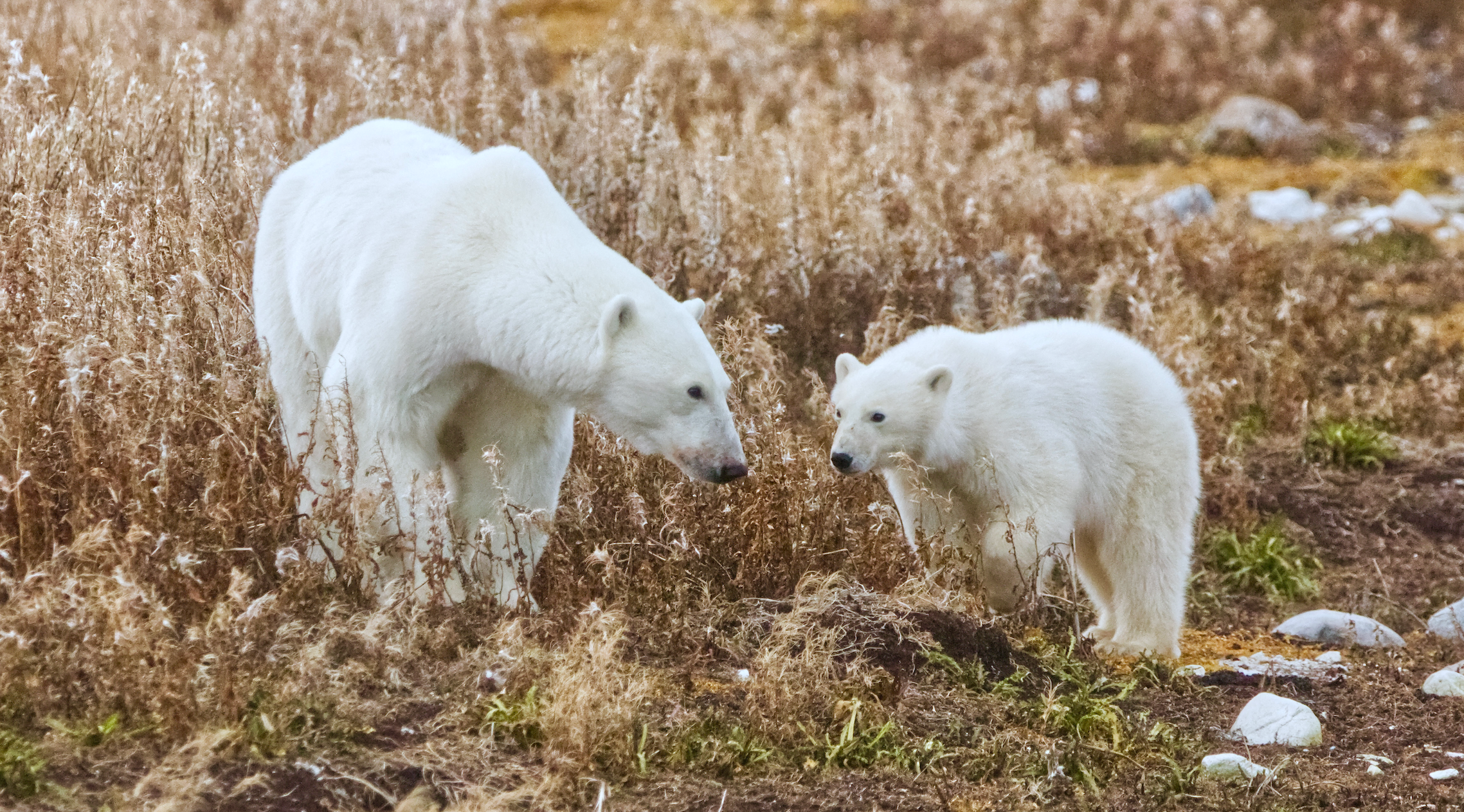
A polar bear and her cub venturing through the taiga vegetation of the Hudson Plains.
From the moment you step off the plane in Churchill, Manitoba, you know you’re in a very special place. Let’s explore the Churchill region's natural history and why it’s so essential to our beloved polar bears.
Churchill was founded at the estuary of the Churchill River, where the river meets Hudson Bay. The Churchill River carves through the Canadian Shield, a massive region of igneous and metamorphic rocks dating back 2.5 to 4.2 billion years to the Precambrian period. During recent (geologically speaking) ice ages, glaciers scraped off much of the topsoil over the Canadian Shield, exposing the ancient bedrock in many places. The impacts of glaciers are seen across the modern landscape as glacial erosion has removed much of the topsoil, carved out lakes, deposited piles of glacial till, and dropped off massive boulders as glacial erratics.
Because of the shallow rocky soil surrounding Churchill, trees in the area are typically stunted. Persistent wind blowing off Hudson Bay further impacts tree growth, creating krummholz formations with trees growing lopsided toward their leeward side.
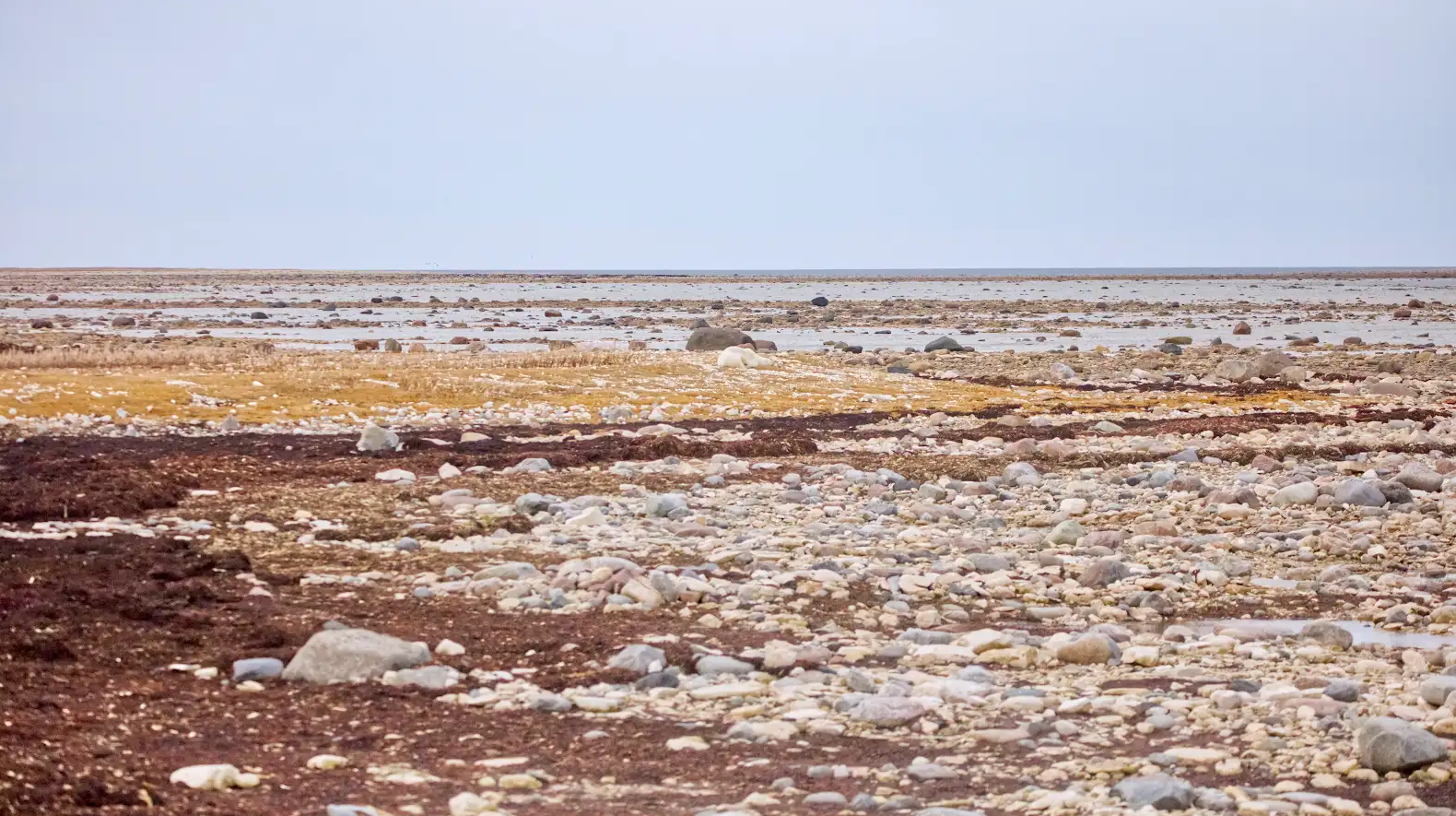
Can you spot the polar bear resting among the rocks and moss on the shores of the Hudson Bay?
The stunted trees around Churchill mark the region where the Boreal Forest gives way to the Arctic tundra. Tundra “proper” refers to regions where the subsoil is permafrost, with permafrost extending from several centimetres to even tens of metres deep. Because the tundra remains frozen year-round, vegetation is largely limited to moss, lichen, grasses, squat trees, and small shrubs. This barren, rocky landscape may seem inhospitable to some, but for many Arctic peoples and animals, it is the perfect home. The Arctic tundra supports a stunning array of animals, including marine life like beluga whales, birds such as white-rumped sandpipers, insects like notorious mosquitoes, and terrestrial mammals including polar bears.
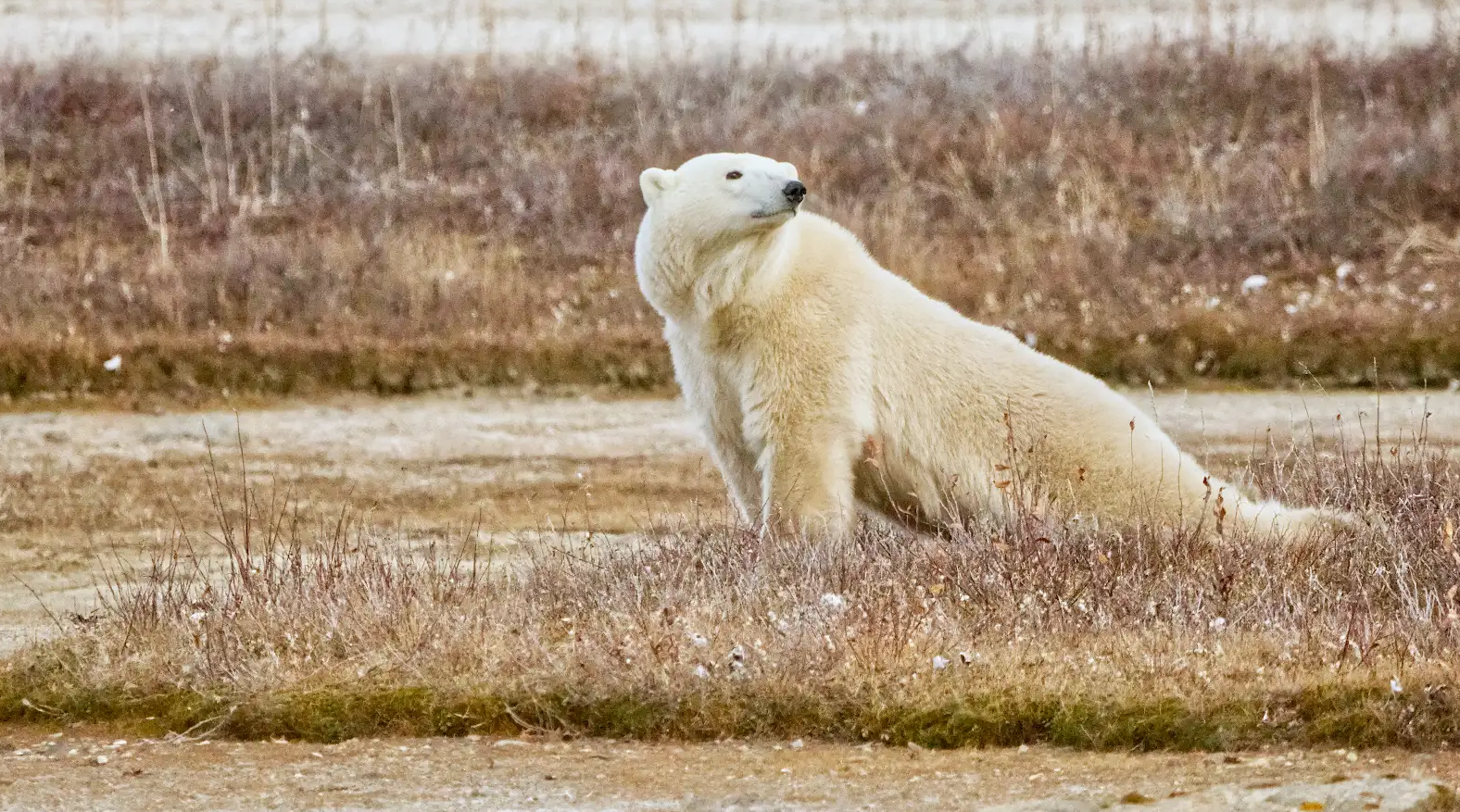
A polar bear waking up from a nap near the Hudson Bay
Why do Polar Bears like Churchill so much?
Churchill’s position at the meeting of marine, boreal, and tundra ecoregions makes it ideal for polar bears. Polar bears are pagophilic, or ice-living, animals that spend much of the year venturing across sea ice in search of prey. During the summer, as the sea ice melts, polar bears venture inland to forage for summer foods, like birds' eggs and berries. These foods sustain them for the brief summer, but are not as nutritious or fatty as their preferred marine prey, like seals. As their diet is restricted throughout the summer, polar bears spend much of the time resting to conserve energy. Each autumn, as the weather cools, polar bears congregate along the shores of Hudson Bay to await the return of sea ice, where they can again hunt for marine mammals. Because freshwater freezes at a higher temperature than salt water, estuaries such as the Churchill Estuary are among the first parts of the bay to freeze. Churchill’s position, jutting into the Hudson Bay, allows ice floes to collect and build up along the shore, providing an excellent early hunting ground for polar bears.
So when you arrive in Churchill on a one-day polar bear expedition, take a moment to appreciate this place’s spectacular meeting of ecoregions, and look for ancient rocks, stunted trees, and polar bears, too.
Written by Joel Weatherly
